
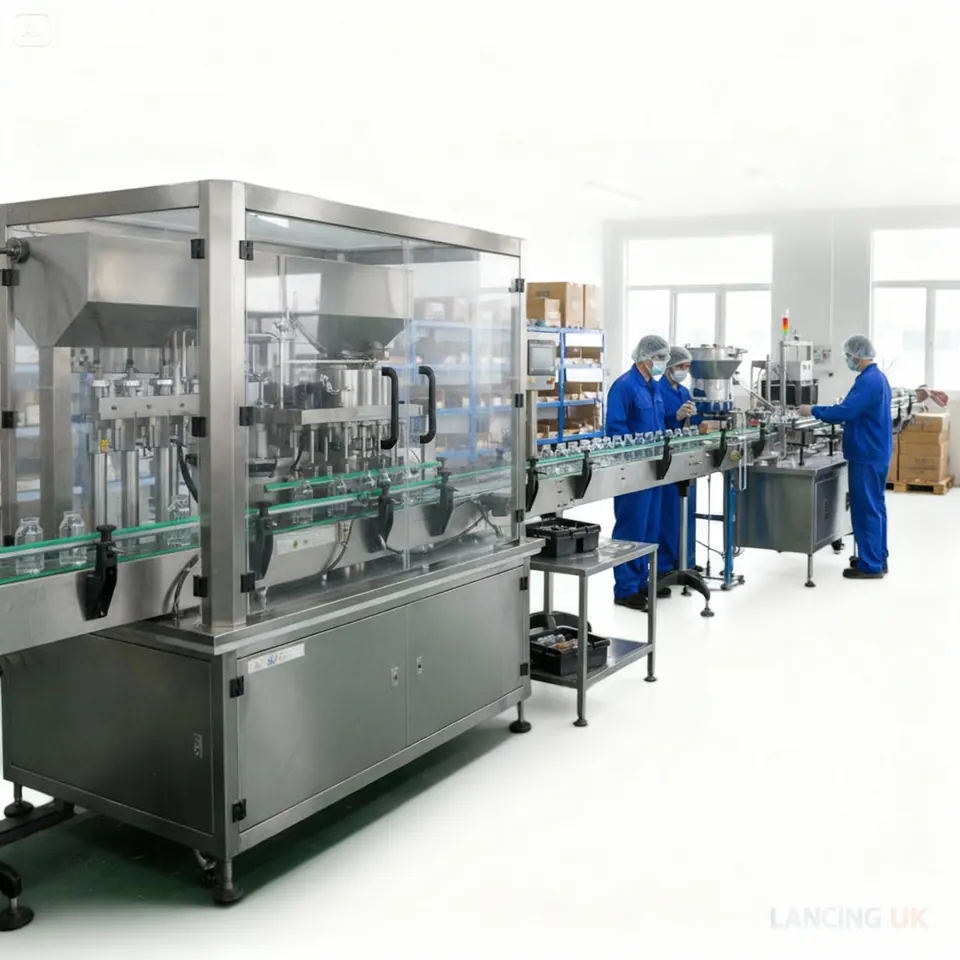
Specification worksheet
Define the result the machine must produce before selecting the technology
A bottle filling machine specification should describe the product and pack operating window, the accepted filled bottle and the production sequence. Model names and headline speeds come later. A complete brief lets suppliers identify where trials, options or site decisions are still required and reduces the risk of comparing machines designed for different assumptions.
1. Product information
| Record | Details to provide | Why it matters |
|---|---|---|
| Product identity | Name, formulation family and safety data where relevant | Defines compatibility, handling and risk-assessment inputs |
| Physical behaviour | Viscosity or flow description, density, temperature range, foam, aeration, stringing and particles | Influences dosing principle, valve, nozzle, fill profile and verification |
| Product supply | Tank, drum, IBC or process feed; height, pressure, agitation, heating and replenishment | Sets the inlet, pump, hopper, level-control and recovery scope |
| Compatibility | Known restrictions for metals, plastics, elastomers, tubing, seals and cleaning chemicals | Applies to the whole wetted path |
| Cleaning | Change frequency, manual or assisted method, drain-down, product recovery and segregation | Changes access, removable parts, valves, hoses and documentation |
2. Fill quantity and presentation
- Minimum, normal and maximum production fill
- Whether the requirement is volume, mass or visible level
- Required headspace and acceptable surface condition
- Measurement equipment, sample size and acceptance method
- Product condition during verification
- Allowed product on the neck, thread, bottle wall or label panel
Where several products use the same nominal volume, record density and temperature separately. Where visible level matters, include actual bottle samples because internal volume and wall shape can vary even when the external bottle looks similar.
3. Bottle and closure matrix
| Pack field | Record for every format |
|---|---|
| Bottle | Material, supplier, drawing, height, width or diameter, base, shoulder, neck finish, opening, weight and rigidity |
| Stability | Empty-bottle behaviour, centre of gravity, tendency to rock, flex or stick, and whether a puck or neck support is acceptable |
| Closure | Cap, pump, trigger, plug, dropper, cork, liner, seal, dip tube and orientation requirement |
| Decoration | Label panel, direct print, sleeve, embossing and surfaces that must remain dry or unmarked |
| Changeover | Expected sequence, frequency, change parts, recipes, tooling and first-off approval |
4. Production requirement
State the accepted output rather than an isolated mechanical cycle. Include normal staffing, batch size, shifts, product and format changes, planned sampling, replenishment and the result required after stops and restarts. Define whether output is measured at the filler discharge or after capping, coding, labelling and rejection.
5. Automation and operator boundary
- Manual bottle loading, conveyor infeed or automatic unscrambling
- Manual or automatic bottle location, filling and release
- Operator placement of closures or automatic sorting and feeding
- Recipe selection, user permissions, production records and fault messages
- Reject handling and disposition of part-filled or unclosed bottles
- Number of operators and tasks expected during steady production
6. Upstream and downstream interfaces
List bottle preparation, rinsing or air cleaning, capping, sealing, coding, labelling, inspection, accumulation and packing. For existing machinery, provide conveyor height and direction, available speed or control signals, bottle transfer details, layout drawings and the party responsible for modifications. Identify whether the filler must stop when downstream equipment blocks and how the line restarts.
7. Site and utilities
Record the available floor area, access route, floor condition, environmental constraints and working clearance. Utilities should be confirmed against the final machine data: electrical supply, compressed air, product feed, water, drainage, extraction, temperature control, data connections and any hazardous-area or chemical-control assessment. Do not select a machine by an assumed utility figure.
8. Safety, documentation and responsibilities
Define the intended use, site risk-assessment boundary, guarding interfaces, isolation points, operator access and any site standard that must be reviewed. List required manuals, drawings, declarations, spare-parts information, training records and software or control documentation included in the project. The buyer remains responsible for site-specific safe use, procedures and competent assessments.
9. Trial and acceptance plan
- Representative products, bottles, closures and quantities available
- Hardest normal formats and product conditions
- Product trial questions before final design
- FAT scope, measurement method, run states and deviations
- Installation completion and SAT scope
- Good-output definition, test duration and stop classification
- Training, handover and first-production support
10. Commercial scope
Ask every quotation to state the supplied machine, tanks, pumps, conveyors, guards, controls, format parts, tools, documentation, trials, freight, installation, training, spares and exclusions. Use the same checklist for every supplier so options are not mistaken for standard scope.