Product feed
Thick products may need an elevated hopper, transfer pump, follower plate or controlled pressure to keep the dosing chamber supplied.

Bottle filling applications
Viscous products need a filling route that controls feed, trapped air, particles, temperature and nozzle cut-off while remaining practical to clean between batches.
Application engineering
A laboratory viscosity or marketing description is not enough. The filler should be reviewed using product at the normal process temperature, representative bottles and the planned supply method.
Application risks
These factors often decide the filling principle, nozzle design, cleaning route and automation level.
Thick products may need an elevated hopper, transfer pump, follower plate or controlled pressure to keep the dosing chamber supplied.
The nozzle and valve must stop the product cleanly enough to protect the neck, seal and label area.
Herbs, seeds, fibres or pieces can restrict valves and nozzles and change dose consistency.
Honey, waxy creams and similar products may need controlled heat or mixing where the formulation allows it.
Recommended starting routes
The table is a shortlist for discussion; trials and detailed engineering determine the final machine.
| Product or production need | Starting approach | Next page |
|---|---|---|
| Piston volumetric filling | Measured positive displacement for a broad range of sauces, creams and gels. | Explore route |
| Semi-automatic paste filling | Hopper-fed operator-loaded filling for short runs and frequent changes. | Explore route |
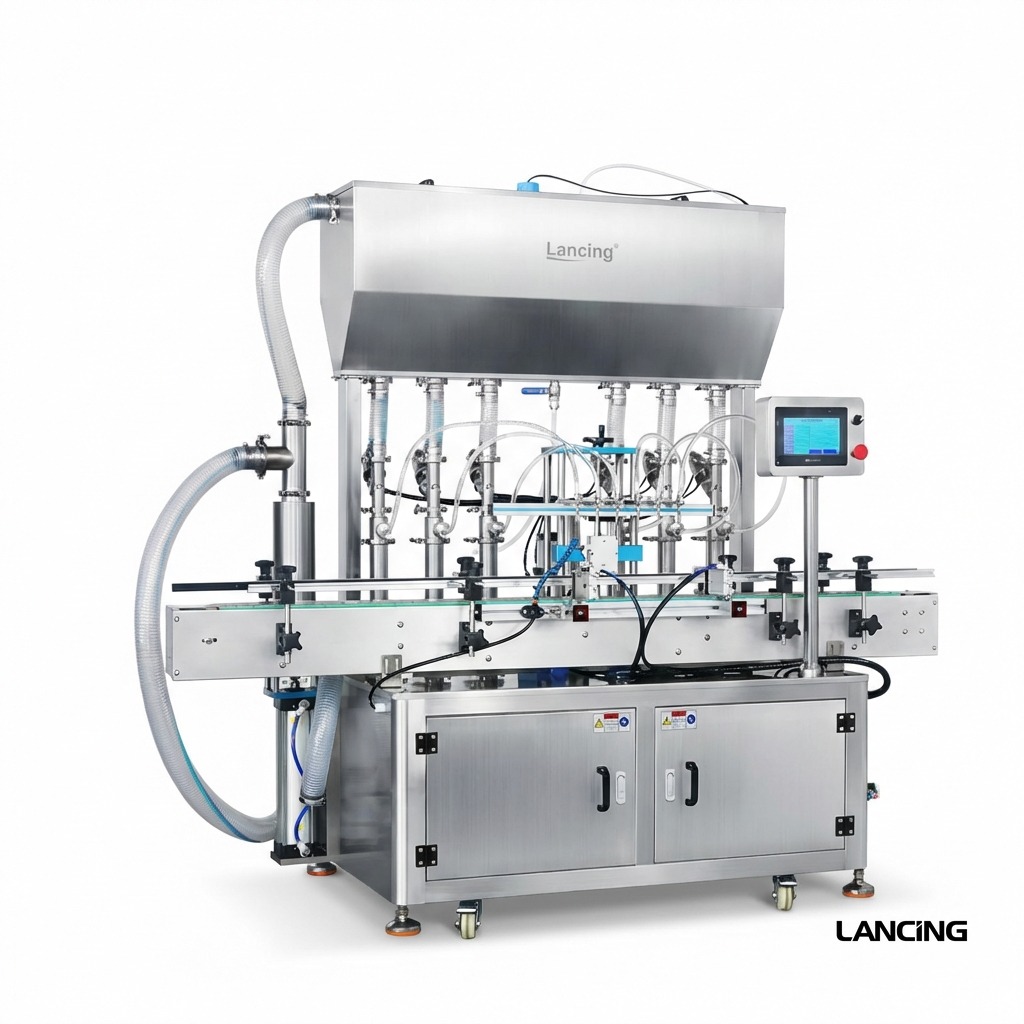
| Automatic multi-head paste filling | Conveyorised, recipe-controlled production with bottle indexing and clean cut-off. | Explore route |
| Positive-displacement pump filling | A pump route for suitable formulations and continuous product supply. | Explore route |
Project information
Clear samples and measurable requirements create a faster, more reliable machinery comparison.
Send specification, SDS where applicable, viscosity range and representative samples.
Provide every bottle, closure, insert and label format—not only the easiest size.
State output by volume, batches, shifts, operators, cleaning and changeovers.
Agree test media, samples, rate, tolerances, documentation and line interfaces.
Questions
Application-specific answers for early project planning.
Some large-bore valves and nozzles can handle particles, but product samples are essential. Piece size, shape and concentration must remain within the agreed path.
Air pockets, temperature, product separation, inconsistent hopper feed and stringing can all change the delivered amount or the measured weight.
They can be considered for suitable formulations, with appropriate control and guarding. Product safety and quality limits must be defined by the user.
Cleaning may involve draining, flushing, product recovery and dismantling of hopper, cylinder, valves, hoses and nozzles. The required method should shape the machine design.
Send product data, representative bottles, closures, fill range and output. Lancing Ltd can identify the most credible filling route.
Bottle and pack evidence
Sauces, creams and similar products can change with temperature, particles, aeration and time. The pack opening, product feed and nozzle shut-off should be tested using representative production material.
Record viscosity, inclusions, fragility, temperature, separation and whether the product strings or settles.
Check the smallest bottle or jar opening, shoulder shape and the required nozzle insertion or cut-off arrangement.
Define product recovery, dismantling, wash method, allergen or colour changes and restart checks.
Include every bottle and closure that is expected to run, not only the easiest format. Note the normal product condition, fill range, batch pattern and the clean presentation required at the next process.
Send application detailsFor a deeper specialist treatment of the dosing technology, continue to Paste Fillers UK. This site retains the bottle-format and container-handling decision.
Positive-displacement option
For suitable pumpable products, piston filling can provide controlled displacement and a defined discharge stroke. Particle passage, cylinder range, product feed, temperature, stringing, valve access and nozzle cut-off must all be tested together.
Recipe-specific trials
A sauce containing herbs, seeds or pieces needs two different checks: how much product reaches the bottle, and whether the bottle contains the required recipe in the required condition. Inspect the supply vessel, transfer system and fill path as one assembly. A wide nozzle does not prove that the upstream valve or pump can handle the same product.
Compare samples from the beginning, normal running and low supply level. Include a normal pause before collecting restarted bottles. Ask the product owner how separation, ingredient damage or a different solids proportion will be judged. Record those findings alongside quantity and neck-cleanliness results.
A smooth cream, emulsified dressing and sauce with inclusions may look similar in a quotation but place different demands on the product path. Identify the formulation used for every recorded result and agree what needs retesting for a changed recipe. Do not assume that the same nominal viscosity means the same passage or cleaning requirement.
The particles, pulp and seeds guide provides the path and sampling worksheet. For a smooth sweet product, use honey and syrup bottling. Include component documentation where the supplied contact materials form part of approval.
For a sauce or cream bottle, agree how the nozzle leaves the pack and what condition is acceptable before closing. Observe representative filled bottles before the cap is applied so that product on the rim, neck or thread is not hidden by the finished pack. Where the recipe includes pieces, ask for the retained samples to be assessed for the product presentation as well as the measured quantity. The trial record should identify the actual formulation used.
It makes the filler’s handover condition visible. A pre-cap check can show whether the neck and closure-contact surfaces meet the agreed standard, helping separate a filling issue from a later closing issue.