
Direct answer
The cost of a bottle filling machine is set by the product, pack, automation and project scope—not by “automatic” or “four head” alone
A useful quotation prices a defined production result. Two machines that look similar can contain different product-contact materials, dosing systems, bottle handling, controls, guarding, change parts, documentation and support. A low headline figure may exclude equipment that another quotation includes. The quickest route to a comparable price is therefore a complete project brief and a line-by-line scope comparison.
This guide does not publish arbitrary price bands. Machinery cost depends on verified requirements, and a generic number can encourage the wrong automation level or omit essential line stages. Use the factors below to establish what each supplier is actually offering.
1. Filling principle and product path
Gravity, piston, pump, peristaltic, overflow, volumetric and net-weight systems solve different product and acceptance problems. The selected principle changes tanks, pumps, cylinders, tubing, valves, seals, nozzles, controls and cleaning access. Corrosive, solvent-bearing, abrasive, hot, aerated, foaming or particulate products can require further material and process review.
2. Fill range, number of products and bottle formats
A single product and bottle at one dose is a different project from a shared machine covering several formulations, wide fill ranges and frequent format changes. Cost can be affected by additional cylinders, pump channels, tubing sets, nozzles, bottle fixtures, guide rails, pucks, star wheels, sensors, recipes and validation work. List the entire range before quotation instead of adding difficult formats later.
3. Automation level and bottle movement
| Scope | What may be included | Cost question to ask |
|---|---|---|
| Manual or operator-loaded | Single station, foot or sensor cycle, bottle fixture and basic controls | What operator actions and separate handling equipment are still required? |
| Semi-automatic multi-head | Several nozzles, shared product supply, bottle support and manual loading/unloading | What output is realistic with the stated staffing and bottle set? |
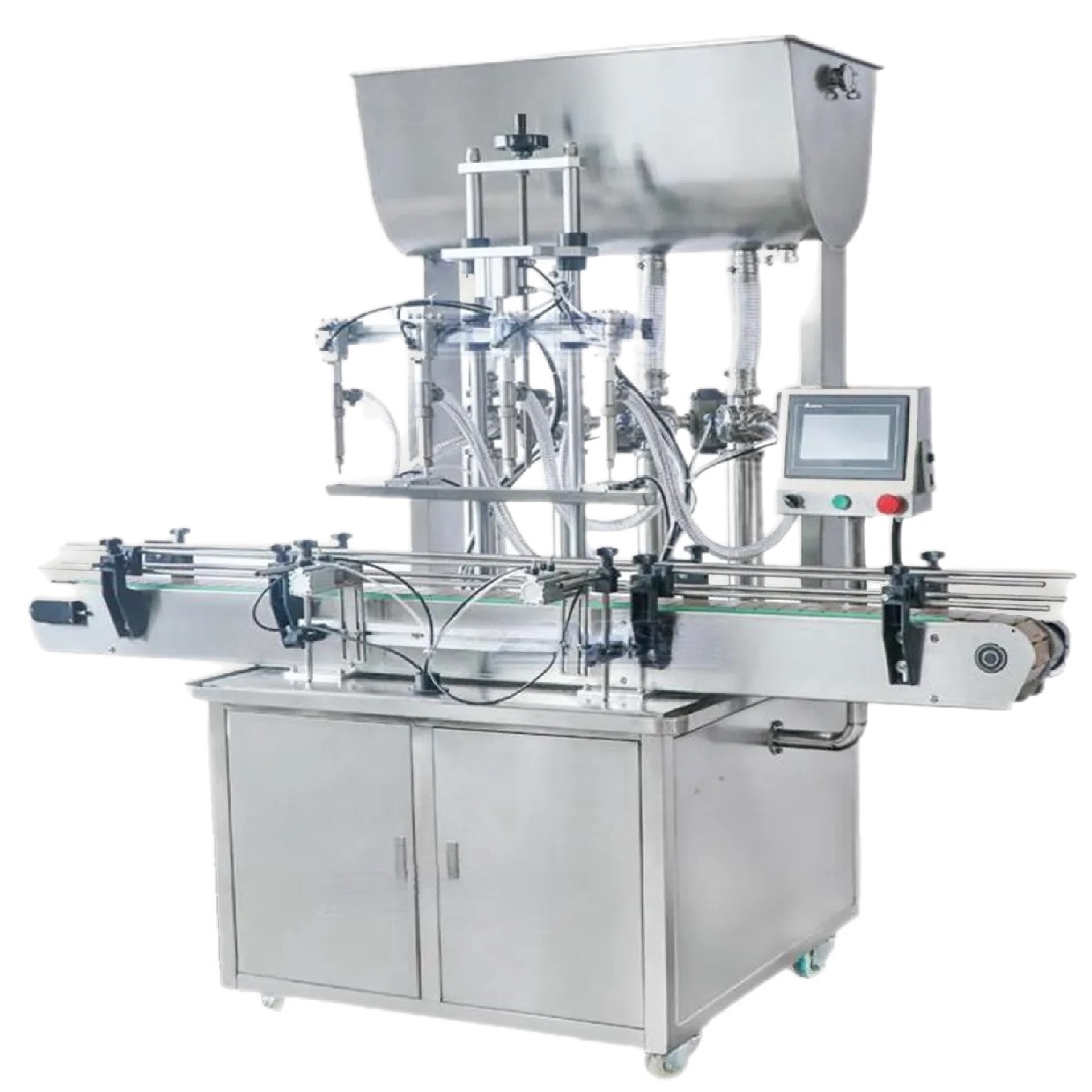
| Automatic inline | Conveyor, bottle detection, gating, indexing, multi-head filling, guarding and HMI | Are infeed, outfeed, accumulation and reject handling included? |
| Complete line | Unscrambling or loading, rinsing, filling, capping, sealing, coding, labelling, inspection and packing interfaces | Who owns controls integration, line balancing and acceptance of the whole system? |
4. Output requirement and line balance
Required good output affects head count, fill profile, indexing method, conveyor capacity, product supply and connected machines. More heads do not automatically create more saleable bottles if capping, labelling, product replenishment or accumulation is the bottleneck. Ask each supplier to state the conditions behind the proposed output and how stops and restarts are treated.
5. Product-contact materials and cleanability
The complete wetted path must suit the formulation and cleaning method. Material selection, seal grade, hose or tubing specification, drainability, removable parts, washdown boundaries, assisted cleaning and product recovery can all change scope. Hazardous substances may require additional risk assessment, ventilation, containment or area classification that should not be assumed from a standard filler.
6. Controls, guarding and integration
Confirm the control platform, recipe scope, fault messages, production counters, data interfaces, guard arrangement, interlocks, emergency stops and energy-isolation boundary included in the price. Existing factory conveyors and machines may need sensors, speed coordination, electrical interfaces or mechanical modifications. A quotation should separate supplied integration from assumptions about third-party equipment.
7. Trials, FAT, SAT and documentation
Representative product trials, factory acceptance and site acceptance require product, bottles, closures, people and time. Clarify the run conditions, measurement method, documents, deviations and retest arrangements. State whether manuals, drawings, parts lists, training records or project-specific documentation are included. Do not compare a demonstration-only quote with a fully defined acceptance package as though the scopes were identical.
8. Delivery, installation, training and production support
Separate the machine price from freight, unloading, access, positioning, utility connection, commissioning, operator training, initial production support and travel. Confirm who provides lifting equipment, electricians, compressed air, product, bottles, operators and measurement equipment. The site must be ready before the installation team arrives.
9. Spares, maintenance and ownership costs
Ask for recommended commissioning spares, routine wear parts, format parts and expected service route. The lowest purchase price may not be the lowest ownership cost if changeovers are slow, product loss is high, cleaning is difficult or parts support is unclear. Conversely, a highly automated line can be unnecessary where batches are short and formats change constantly.
Build a like-for-like comparison
| Comparison heading | Record for every quotation |
|---|---|
| Products and conditions | Exact formulations or product families, temperature, viscosity, foam, particles and compatibility assumptions |
| Pack range | Bottle and closure list, fill range, change parts, exclusions and sample status |
| Accepted output | Good bottles, staffing, test duration, changeover assumptions and downstream scope |
| Machine scope | Filler, tank, pump, conveyor, guards, controls, nozzles, tools and included options |
| Project services | Trials, FAT, freight, installation, SAT, training, documentation, warranty and support route as quoted |
| Exclusions and assumptions | Utilities, lifting, building work, product supply, third-party interfaces and site responsibilities |