
Direct answer
Site preparation should be part of the machinery specification, not a task left until delivery week
A bottle filler can be correctly built yet difficult to install if the delivery route, floor, utility points, service access or connected conveyors were assumed. Start with an approved layout and responsibility matrix. Every connection and clearance should be confirmed against the final machine documentation rather than copied from another project.
1. Confirm delivery and positioning access
- Vehicle access, unloading location and site booking requirements
- Crate and machine dimensions, weight and centre-of-gravity information supplied for the project
- Doorways, corridors, lifts, stairs, overhead services and turning space
- Competent lifting plan, equipment, permits and responsible contractor
- Temporary removal of doors, barriers or existing machinery where agreed
- Secure storage for change parts, tools, manuals and loose components
Do not improvise lifting points. Use the supplier’s instructions and a competent lifting plan. Photograph delivery condition before unpacking and record transit damage or missing items immediately.
2. Prepare the machine area and floor
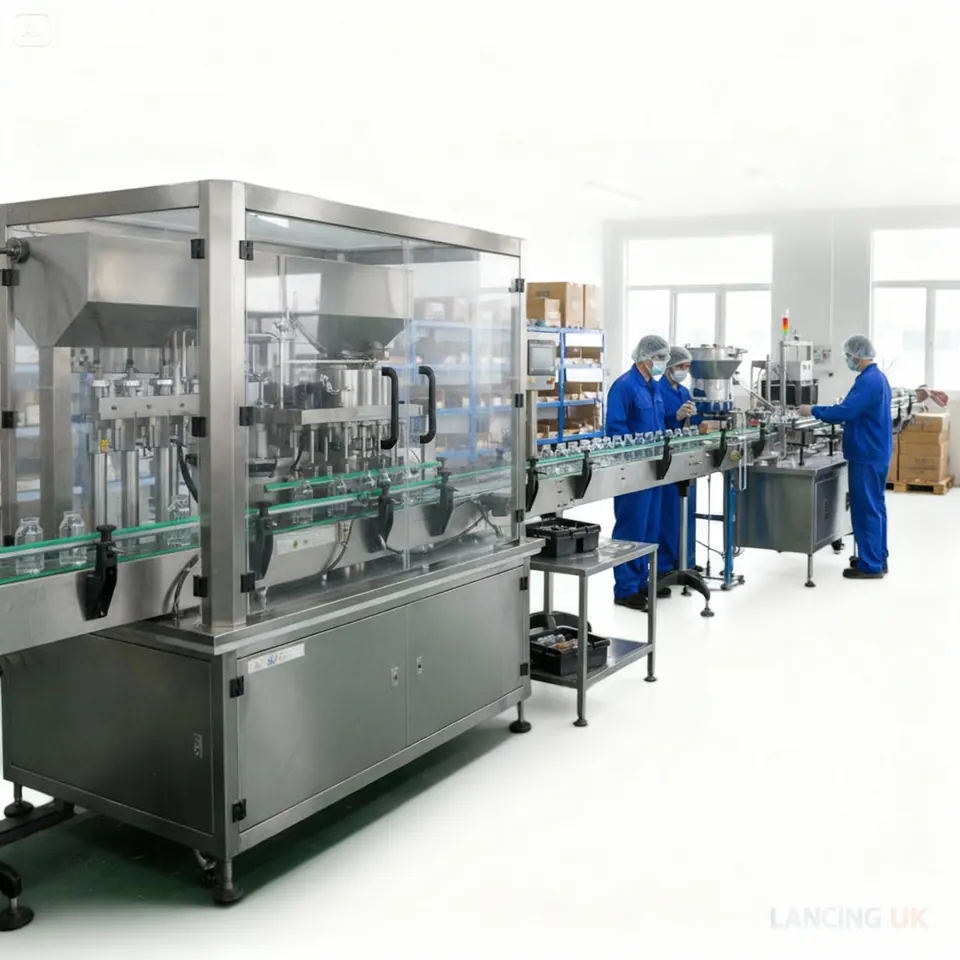
The floor must suit the installed load, level and anchoring method stated for the machine. Mark the equipment footprint, conveyor centreline, operator positions, guard doors, electrical panels, tanks and product connections. Retain service access around pumps, cylinders, cabinets, filters, change parts and removable product-contact assemblies. Keep emergency routes and fire-safety provisions clear.
3. Freeze the line layout and bottle flow
| Interface | Confirm before installation | Typical risk if omitted |
|---|---|---|
| Upstream bottles | Manual loading, unscrambler or conveyor; flow direction; height; guides; accumulation | Starvation, unstable transfers or inaccessible loading |
| Product supply | Source vessel, route, connection, pressure or head, pump ownership and replenishment | Air entry, starvation, uncontrolled pressure or difficult cleaning |
| Downstream equipment | Capping, sealing, coding, labelling, inspection, accumulation and control signals | Blocked transfers, mismatched speed or unclear stop logic |
| Rejects and samples | Where incomplete, suspect or sampled bottles are removed and recorded | Uncontrolled product or rejected bottles returning to good output |
4. Confirm utilities from the final data sheet
Record voltage, phase, frequency, protective device, isolation point, cable route and earthing requirements. Where compressed air is used, confirm required pressure, flow, quality, connection and isolation. Product, water, drainage, extraction, temperature-control and data connections must also match the final machine scope. Utility values vary by machine; do not use generic figures from a web page.
Position connection points so hoses and cables do not create trip hazards, obstruct guard doors or pull on weighing and filling components. Define who supplies final tails, fittings, regulators, filters and isolation hardware.
5. Define the product and cleaning boundary
Show how product reaches the filler, how it is isolated, drained, recovered and cleaned, and where waste or rinse liquid goes. Chemical or hazardous products require a site-specific assessment using the safety data and actual process. Confirm containment, ventilation, spill response and cleaning-chemical controls with competent site personnel.
6. Complete safety review and pre-use inspection
The buyer and employer have responsibilities for safe installation and use. HSE guidance explains that work equipment whose safety depends on installation conditions should be inspected after installation and before first use, with the need and scope determined through risk assessment. Review guarding, interlocks, emergency stops, isolation, stored energy, access and interfaces with existing machinery before production.
Authoritative references: HSE PUWER overview and HSE work-equipment inspection guidance.
7. Prepare commissioning materials and people
- Representative product in the agreed condition and quantity
- Every bottle, closure and change part included in the commissioning scope
- Labels, codes, seals or other materials needed by connected equipment
- Named engineering, production, quality and safety contacts
- Operators available for training and production handover
- Calibrated or agreed measurement equipment for acceptance checks
8. Separate installation completion, commissioning and SAT
Installation completion confirms the machine is positioned and connected. Commissioning establishes settings and functional operation. SAT records the agreed tests in the production environment. Use a punch list for outstanding work and identify whether each item prevents safe operation, prevents acceptance or can be completed after controlled handover.
9. Plan operator and maintenance handover
Handover should cover start-up, shutdown, recipes, changeover, cleaning, fault response, safe isolation, routine checks, consumables and who to contact for support. Record the delivered manuals, drawings, parts information, backups and change-part inventory. Training should use the actual product and pack where possible.