Flexible production
Semi-automatic filling
Operator-loaded filling can suit lower volumes, varied products or staged investment. The full lift, place, fill, remove and cap cycle must be assessed ergonomically.
Review semi-automatic routes
Large bottle filling
Five-litre bottles need more than a large dose setting. The filler must manage product flow, bottle weight and stability, neck access, operator handling, conveyor transfer and the closure process as one practical production task.
Direct answer
A five-litre bottle can be filled by semi-automatic piston, pump or weight-based equipment, or by an automatic multi-head line. The correct route depends on the liquid or paste, bottle construction, dose acceptance, required good output, operator handling and whether capping and labelling are included.
Operator-loaded filling can suit lower volumes, varied products or staged investment. The full lift, place, fill, remove and cap cycle must be assessed ergonomically.
Review semi-automatic routesPositive displacement, controlled pump time or net-weight control can each be suitable. Product behaviour and the required acceptance method decide the shortlist.
Compare net-weight fillingConveyorised systems reduce manual bottle movement and can connect directly to capping, coding and labelling equipment.
Review automatic fillersBottle handling
A five-litre container becomes a heavier finished pack. Its base, handle, wall stiffness and centre of mass affect operator handling and automatic transfer.
Selection comparison
Start with the project constraints rather than assuming that one dosing principle is best for every five-litre product.
| Method | Useful starting point | Important limitation to test |
|---|---|---|
| Piston filling | Repeatable volumetric dosing of pumpable liquids or pastes using a selected cylinder range. | Product compressibility, particles, valve path, cleaning and whether one module covers the required doses. |
| Gear or diaphragm pump filling | Controlled transfer of suitable liquids, with flow and cut-off matched to the product. | Metering repeatability, pump compatibility, air in the supply and nozzle shut-off. |
| Net-weight filling | Projects where mass is the agreed quantity measure or density varies enough to make volume less useful. | Stable weighing, vibration, bottle handling and the fill profile near target weight. |
| Gravity filling | Readily flowing still liquids supplied from a controlled head or tank. | Pressure/head variation, foam, tank level and whether quantity or visible level is the main criterion. |
| Automatic multi-head filling | Higher-output projects with repeatable bottle presentation and integrated downstream operations. | Line balance, bottle accumulation, stops, restarts and realistic good output at five litres. |
Verified Lancing example
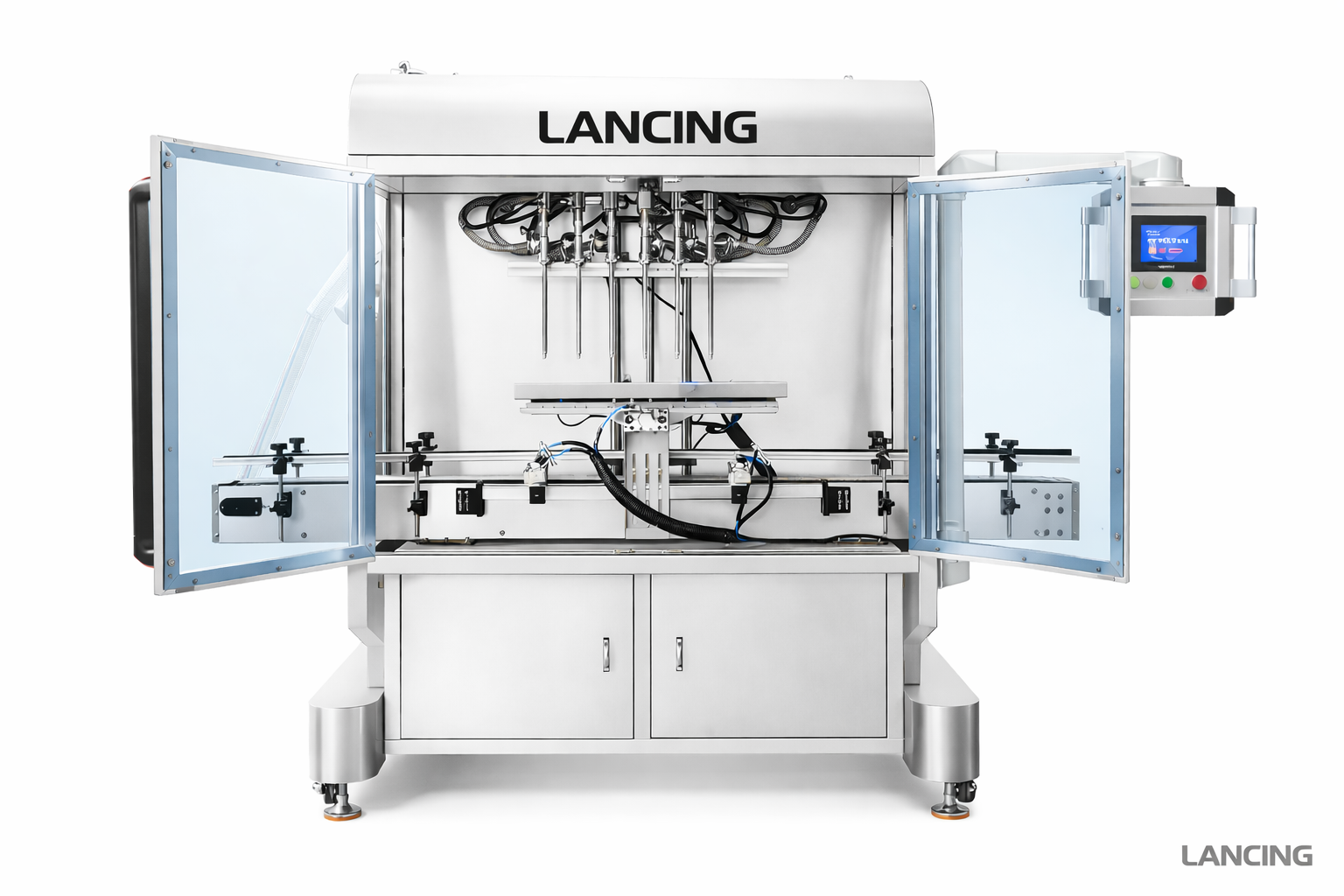
The LU-CL6T is one automatic Lancing route that reaches a published five-litre dose. It is not the only option and should not be selected without checking the liquid, bottle and required line rate.
Buyer checklist
Buyer questions
It can be, especially for lower output or varied products. The evaluation must include the full operator cycle and safe handling of the heavier filled pack, not only the machine’s dose time.
Automation becomes more attractive when repeatable output, reduced manual lifting, direct capping or labelling, and stable bottle flow justify conveyor handling. The complete line should be timed with real product and bottles.
There is no universal best method. Piston, pump, gravity and net-weight systems can all be credible. Product flow, density, foam, particles, accuracy method, cleaning and output determine the right route.
Control may include suitable nozzle entry, bottom-up filling, staged flow, adequate headspace, stable product supply and time for foam to settle before capping. The actual formulation must be tested.
Often within an agreed format range, but handles, base geometry, wall stiffness, neck position and closure finish can require guide, stop, height or nozzle adjustments. Send every critical bottle for review.
Measure accepted finished packs over a representative run including bottle loading, filling, capping, planned stops, restarts and normal operator tasks. Headline cycles alone do not describe good production output.
Send the product, bottle, closure, output and line scope for a practical large-container filling shortlist.