Maintain product supply
The storage tank and level controls must keep the pumps supplied without adding avoidable air, foam or pressure variation.

Verified Lancing machine
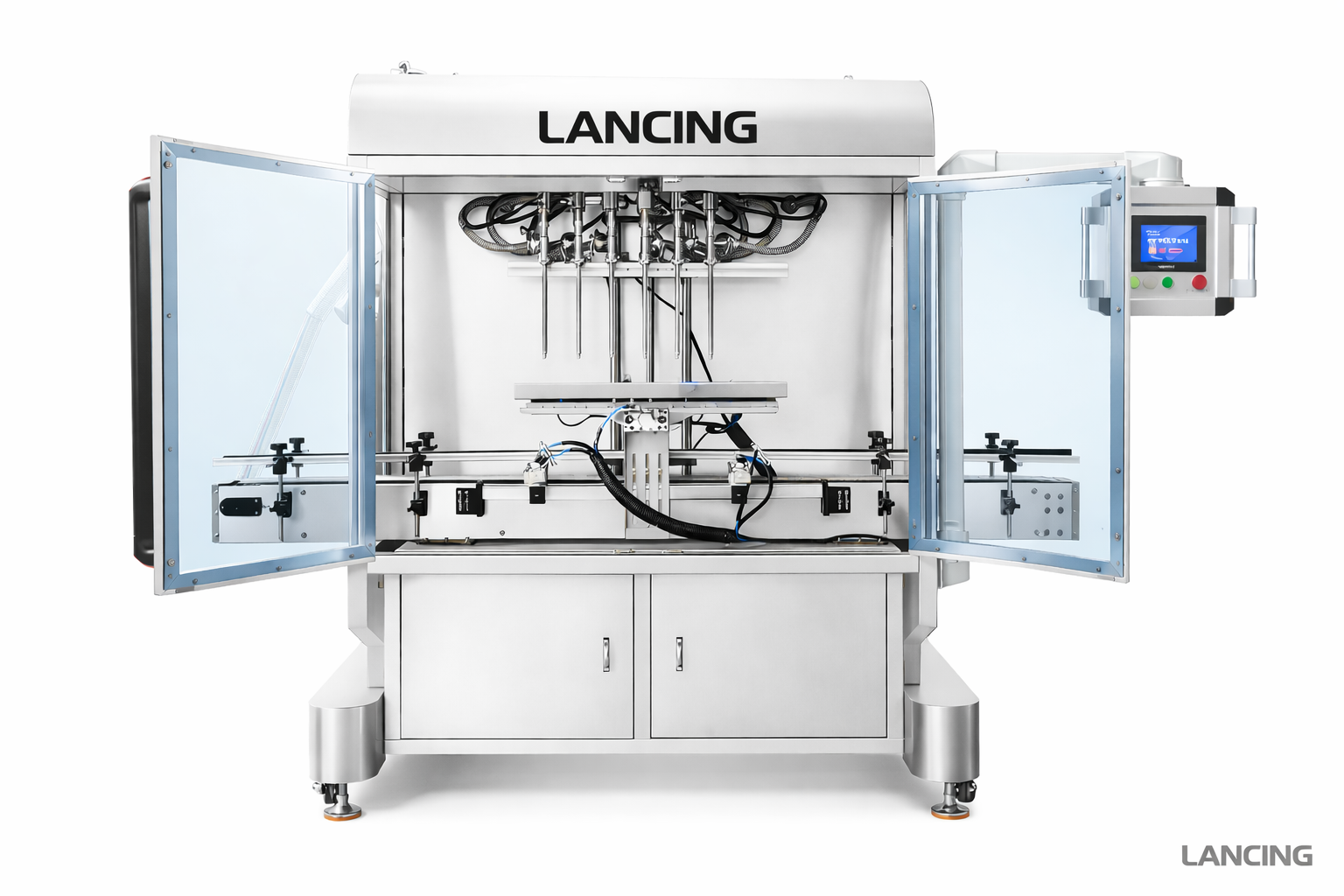
The LU-CL6T is a six-head automatic liquid filling machine with servo-driven magnetic pumps, designed around 500–5000ml fills. Final output, bottle compatibility, product contact parts and utilities are confirmed against the real application.
Direct answer
The Lancing LU-CL6T is an automatic, conveyor-fed liquid bottle filler for projects requiring several filling heads and a multi-litre dose range. Six independent servo-driven magnetic pumps meter product to six nozzles. The reference machine covers 500–5000ml, but suitability must be confirmed with the actual liquid, bottle, production rate and cleaning requirement.
Verified reference data
These figures describe the published reference configuration. Options, real product behaviour and the complete line can change the final result.
| Item | Published reference | Project check |
|---|---|---|
| Model | LU-CL6T | Confirm the exact quoted revision and selected options. |
| Filling range | 500–5000ml | Trial the minimum, normal and maximum required doses. |
| Filling heads | Six, with published 8mm head size | Check neck opening, spacing and product flow. |
| Filling pumps | Six servo-driven magnetic pumps | Confirm wetted-part compatibility and actual liquid performance. |
| Reference capacity | Maximum 42 bottles/min at 500ml | Do not apply this figure to another dose or product without a timed trial. |
| Bottle envelope | Height up to 330mm; diameter up to 110mm | Send every bottle variant, including the least stable pack. |
| Storage tank | 320 litres | Review refill method, usable volume, level control and cleaning. |
| Machine size | 2615 × 1621 × 2153mm | Allow for access, services, guarding and line interfaces. |
| Machine weight | 752kg | Confirm floor and handling arrangements with the final layout. |
Operating sequence
The automatic cycle depends on coordinated product supply, bottle positioning, independent dosing and clean release to the next station.
The storage tank and level controls must keep the pumps supplied without adding avoidable air, foam or pressure variation.
The conveyor, bottle stop and guides present a stable group beneath the nozzles. The least stable bottle should be tested.
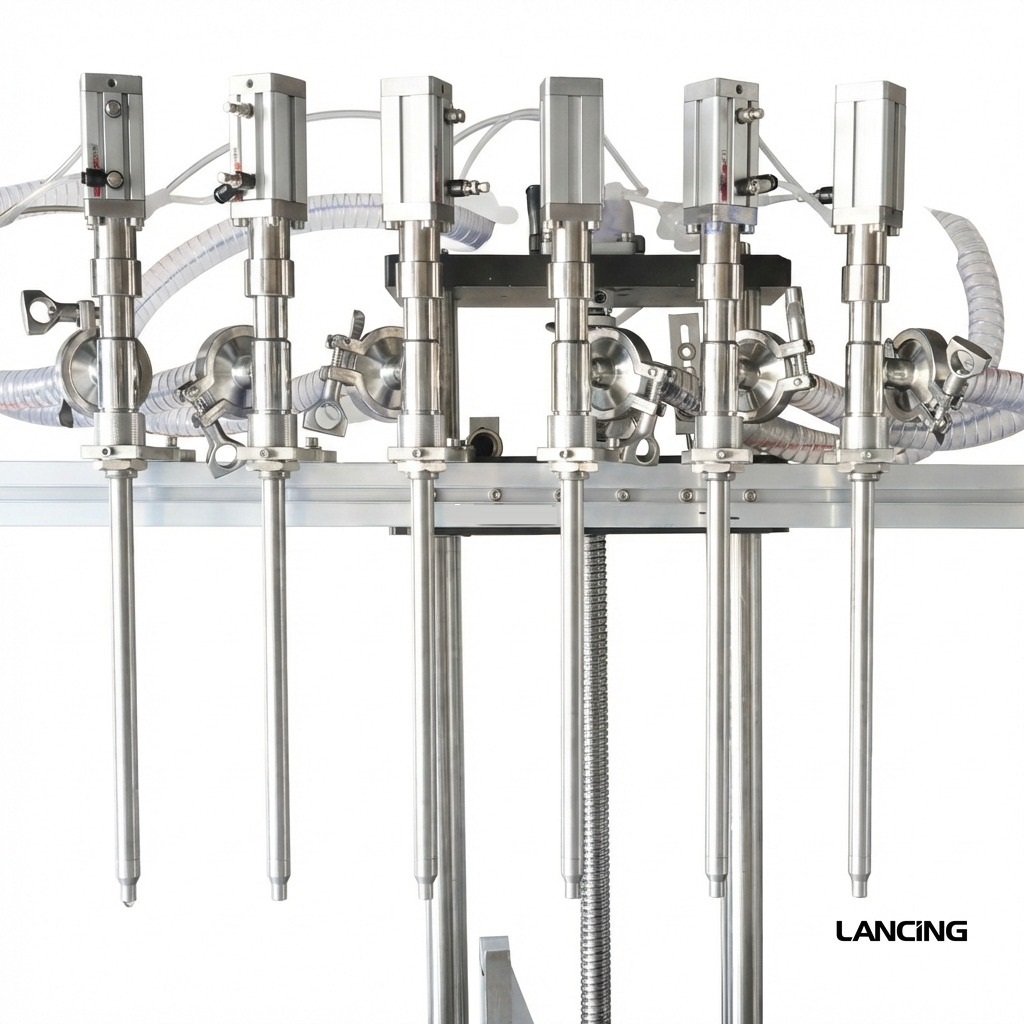
Servo-controlled lifting positions the filling heads. Each magnetic pump meters its channel using the agreed recipe and fill profile.
The nozzles retract, the drip-control arrangement protects the bottle finish, and filled bottles move to the next operation.
Independent pump channels allow each filling position to be adjusted during commissioning. This can help compensate for measured channel differences, but it does not remove the need for a controlled product supply, a stable bottle and an agreed verification method.
Quantity acceptance should state whether the project is checked by mass, volume or another agreed method. Visible fill level should be assessed separately because bottle geometry and manufacturing variation can affect the apparent level.
Trial and acceptance
A useful test should reproduce the product, bottle and operating conditions that determine real output and presentation.
Provide normal and worst-case viscosity, temperature, foam, aeration, particles, corrosivity and cleaning information.
Include minimum and maximum bottles, different necks, light or flexible packs and the closure intended for the next station.
Agree start-up, steady running, stops, restarts, quantity checks, bottle cleanliness and the number of acceptable finished bottles.
Buyer questions
These answers explain how to use the published model data without treating it as a universal performance guarantee.
The LU-CL6T should be considered for liquids that can be supplied consistently to its magnetic pumps and nozzles. Product chemistry, viscosity, temperature, foam, particles and wetted-part compatibility must be checked before the model is confirmed.
Yes, five litres is within the published 500–5000ml reference range. The bottle must also fit the height and diameter envelope, remain stable on the conveyor and provide enough neck access for the selected nozzle.
No. The published maximum is referenced at 500ml. Actual good output depends on the liquid, dose, bottle indexing, nozzle movement, settling time, stops, restarts and downstream equipment. A timed trial is required for the project rate.
Agree the measurement method, sample size, product condition and allowable result before testing. Quantity, visible fill level, neck cleanliness and good-output rate should be recorded as separate acceptance criteria.
Yes. The conveyorised filler can be planned with bottle infeed, capping, sealing, coding, labelling, inspection and accumulation. Control interfaces and line balance should be included in the scope rather than added after machine selection.
Send product data, representative liquid, every bottle and closure, fill range, required good output, batch pattern, cleaning method, site utilities, available space and the intended upstream and downstream equipment.
Send the liquid, bottle set, fill range, target good output and line scope for a configuration review.