Before filling
Control bottle presentation
Confirm unscrambling or manual loading, spacing, sensor response, guide rails, empty-bottle cleaning and stop/restart behaviour.

Automatic liquid filling
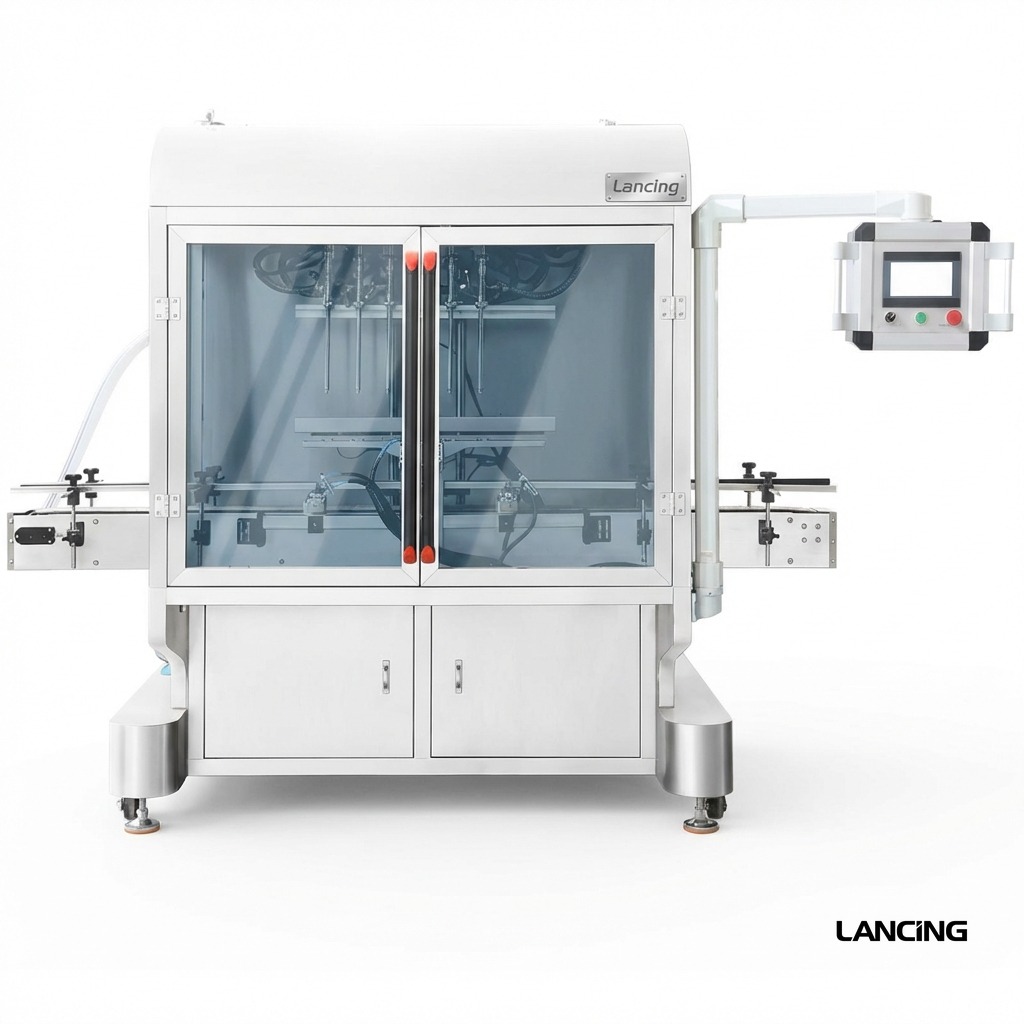
The LU-YT4T-4D is an automatic inline liquid filler using lifting nozzles, PLC control, bottle detection and conveyor handling. It is a starting route for suitable foamy and non-foamy products, subject to product and bottle trials.
Direct answer
The LU-YT4T-4D should be shortlisted when an automatic liquid filling project needs controlled nozzle movement, conveyor-fed bottles and recipe-based operation. Lifting nozzles can support bottom-up or staged filling for suitable foaming liquids, but the fill profile, bottle neck, product behaviour and required output must be proven together.
Selection evidence
Use the first-party description to establish the machine family, then use a project trial to establish the actual configuration.
| Published feature | Why it matters | What Lancing must confirm |
|---|---|---|
| Lifting filling nozzles | Allows the nozzle position and movement to be coordinated with the liquid level. | Travel, speed profile, clearance and whether bottom-up filling improves the actual product. |
| PLC control | Supports repeatable recipes, timing and controlled automatic sequences. | Recipes, access levels, alarms, data needs and interfaces with the wider line. |
| Bottle detection | Links filling to the presence and position of bottles. | Sensor technology, bottle colour or transparency, spacing and no-bottle-no-fill logic. |
| Conveyor handling | Moves containers through the automatic fill station. | Guide rails, bottle stops, pucks, indexing method and line height. |
| Selectable dose modules | The first-party page lists modules from small to multi-litre fills. | The exact module, head count and usable project range must be stated in the quotation. |
Foam and presentation
A diving nozzle is useful only when its movement improves the actual liquid and bottle. The trial should compare fill time, foam height, settling, neck cleanliness and repeatability.
Line integration
The automatic filler should exchange clear control states with the bottle infeed, closure equipment and downstream inspection or accumulation.
Confirm unscrambling or manual loading, spacing, sensor response, guide rails, empty-bottle cleaning and stop/restart behaviour.
Specify product supply, low-level control, bottle gating, nozzle movement, overflow protection and fault recovery.
Allow enough settling and transfer control before cap, pump or trigger placement, coding, labelling and inspection.
Buyer questions
No. Lifting nozzles and a staged fill profile can reduce foam for suitable liquids, but formulation, temperature, product supply, nozzle diameter and headspace still control the result. Representative product testing is required.
The first-party page lists several selectable dose modules spanning small to multi-litre fills. Because that page also contains model-label inconsistencies, the exact fitted module and usable project range must be confirmed in the written quotation.
Potentially, but bottle detection, stability and neck access must be tested. Transparent, reflective, flexible or unusually shaped containers can require different sensors, guides, pucks or indexing arrangements.
Realistic output is measured with the actual liquid, dose and bottle while including indexing, nozzle movement, foam settling, stops, restarts and downstream restrictions. Record good finished bottles rather than only theoretical fill cycles.
State the products, change frequency, allowed cleaning media, drain-down expectations, cross-contamination limits and whether hoses, nozzles or dosing components must be removed between batches.
Send representative liquid, every bottle and closure, dose range, target good output, current process, batch pattern, cleaning method, available utilities, space and required connections to capping or labelling equipment.
Lancing can compare the LU-YT4T-4D with other automatic filling methods and define the remaining trial evidence.