Prepare product
Load the hopper with representative product at the normal operating temperature and remove avoidable air or unmixed material.

Semi-automatic filling
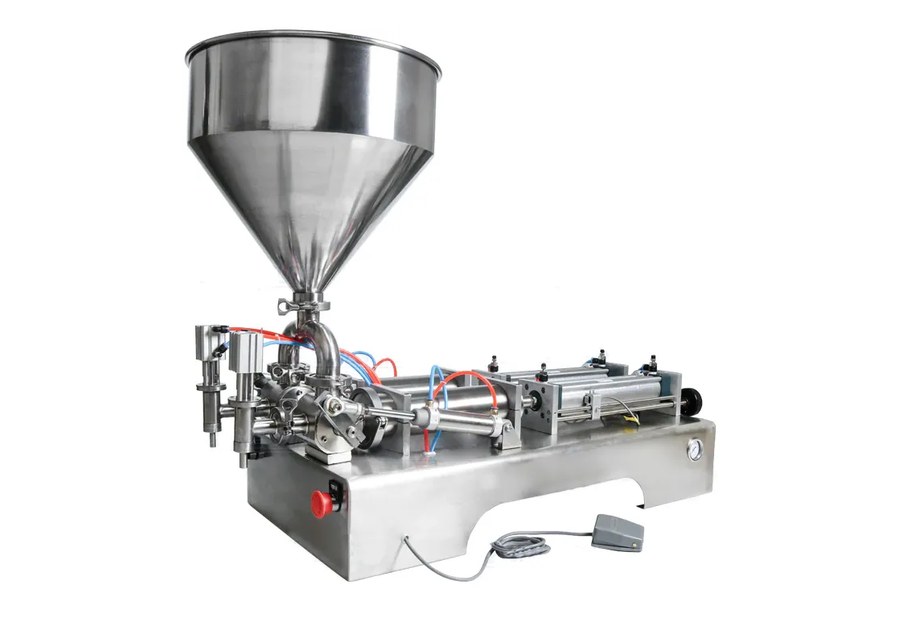
The LU-GT1V is a fully pneumatic, operator-loaded filling machine with a hopper-fed dosing arrangement. Lancing describes reference modules covering 5–1000ml and a 30-litre hopper; the final module and product path are selected around the real product and container.
Direct answer
The LU-GT1V is intended for semi-automatic dispensing of suitable liquids and pastes into operator-positioned containers. Compressed air drives the filling mechanism. A hopper presents product to the dose system, and the operator controls bottle placement and cycle initiation. Product trials decide the correct volume module, nozzle and settings.
Reference configuration
The machine family is straightforward, but repeatable results depend on matching the dose module and product feed to the actual formulation.
| Item | Published reference | Selection question |
|---|---|---|
| Drive | Fully pneumatic | What clean compressed-air supply is available at the installation point? |
| Product supply | 30-litre hopper | Will the product settle, separate, cool, skin, aerate or require agitation or heating? |
| Reference fill modules | 5–1000ml across selectable module sizes | Which minimum, normal and maximum doses must one fitted module cover? |
| Containers | Operator-loaded | How will the bottle be located at a repeatable nozzle position? |
| Output | Application dependent | What full operator cycle and good-output rate must be achieved? |
Operator cycle
The operator remains part of the production cycle, so ergonomics and bottle presentation should be tested alongside dose repeatability.
Load the hopper with representative product at the normal operating temperature and remove avoidable air or unmixed material.
Place the container against the agreed stop, nest or support so the neck remains centred beneath the nozzle.
Initiate the pneumatic cycle using the selected control method while keeping hands clear of moving parts and the fill area.
Check quantity and neck cleanliness, remove the filled bottle and present the next container without disrupting the fill settings.
Product and cleaning
Products that look similar can behave differently under suction, compression and nozzle cut-off.
Buyer questions
The LU-GT1V can be considered for pumpable liquids and pastes that can be fed from its hopper and dispensed through the selected valve and nozzle. A trial must confirm viscosity, particles, chemical compatibility, cut-off and cleaning.
Not necessarily. The published range describes selectable module options across that span. The fitted dosing module should be chosen around the minimum, normal and maximum doses required by the project.
The filling mechanism is described as fully pneumatic, so compressed air is essential. Any auxiliary equipment, sensors or optional controls must be confirmed in the final specification rather than assumed.
The full cycle depends on product refill, dose time, bottle placement, operator movement, inspection and removal. Time the whole representative cycle and measure accepted bottles, not only the machine stroke.
No. Some products may settle, cool, skin, separate or trap air. Hopper geometry, agitation, heating, level control and refill method should be reviewed against the product and batch process.
Provide the product, SDS where relevant, viscosity and temperature range, sample, bottle and closure, dose range, batch size, target output, cleaning method, compressed-air details and available workspace.
Send representative product, containers, dose range and target output for a practical semi-automatic filling review.